
Jovita Idar Quarter Varieties with Defects
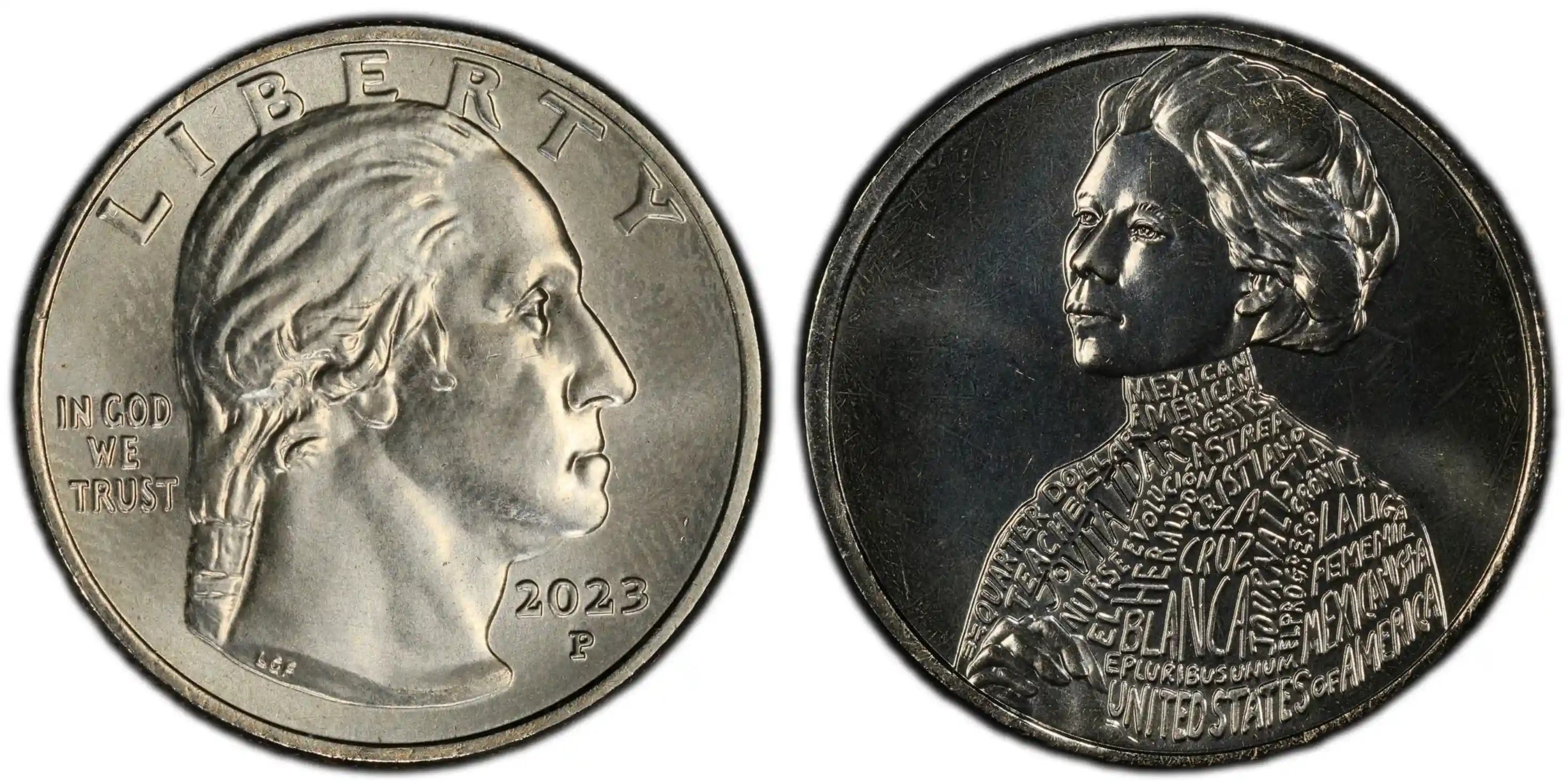
The Jovita Idar quarter error list contains die cracks and off-center strikes with $20 average price. A missing clad layer defect can cost more than $400.
2023 Jovita Idar Characteristics & Design
Year | 2023 |
Diameter | 24.26 mm |
Weight | 5.67 g |
Composition | Copper / Nickel |
Edge | Reeded |
The intricate work by Medallic Artist John P. McGraw squeezed an unprecedented amount of detail onto a small metal planchet.
Text Integration and Die Stress Points
In contrast to traditional coins that feature large fields of smooth metal, the Jovita Idar quarter reverse leaves almost no empty space. Layering numerous small inscriptions across her dress created deep, narrow crevices inside the steel production dies.
The microscopic channels between letters act as traps for machine grease and metal debris.
The sharp angles of the text shapes create intense localized stress during impact.
The continuous pressure causes micro-fractures to spread quickly across the die face.
These stress points forced the steel dies to fail far earlier than their projected lifespan, which left a trail of distinct variations in circulation before quality control workers noticed the deterioration.
The Laura Gardin Fraser Obverse Variance
The front of the coin utilizes the right-facing portrait of George Washington, originally designed by Laura Gardin Fraser in 1932. This design features a high, thick profile that requires immense hydraulic force to execute sharply.
When the mint press delivers the high tonnage necessary to fill out Washington's hair details on the front, the opposite side must absorb that same energy across the delicate text fields of Idar's dress. This imbalance frequently caused the metal blanks to shift or forced the dies to chip and split under the absolute limit of the machinery's capability.
Famous Text and Legends Defects: The "Cod" Variant
The most famous errors on the Jovita Idar quarter involve the inscriptions on both sides of the coin. Lettering defects always attract strong interest from the public due to their obvious visual impact.
The "In Cod We Trust" Grease Struck-Through
The In Cod We Trust error has become a viral sensation among casual pocket-change hunters. This defect occurs on the obverse side next to Washington's profile.
During high-speed mint operations, heavy industrial lubricant coats the moving parts of the press. Excess grease frequently breaks free and mixes with tiny flakes of metal dust to form a thick sludge. This paste packs tightly into the small, curved recess of the letter "G" in the word "GOD."
When the die slams down onto the coin blank, the trapped grease acts as a solid barrier. It blocks the copper-nickel clad metal from flowing upward into the die cavity. The resulting strike leaves a smooth, rounded shape that explicitly reads as a letter "C."
Missing Text and Faded English & Spanish Mottos
The grease blockages and uneven distribution of mechanical pressure also wreaked havoc on the multi-word reverse design. The inscriptions inside the dress pattern frequently show varying degrees of completeness.
Affected Text Area | Visual Indicator | Primary Production Cause |
E PLURIBUS UNUM | Letters fade completely into the background fields | Insufficient die strike pressure or light grease film |
MEXICANA / TEXT | Specific letters on the dress lines appear flat or missing | Heavy grease packing within the dress folds |
QUARTER DOLLAR | Soft, indistinct edges along the base text rim | Die misalignment or planchet thickness variation |
Structural Die Defects: Hair Cracks and Forehead Chips
As steel dies smash into hundreds of thousands of hard metal blanks, the structural integrity of the tool breaks down completely.
The Jovita Idar Hairline Die Cracks
Die degradation often manifests as spiderweb-like cracks on the coin surface. On the reverse of the Jovita Idar quarter, these fractures regularly occur around the 12 o'clock position near the rim.
Tiny fissures open in the steel tool, which allows the raw coin metal to squeeze inside during a strike. This action leaves raised, thin lines of metal that run through her hair buns, across her forehead, and down toward her eye line.
The "Forehead Mole" and "Third Eye" Die Chips
When small fragments of the steel die face break away entirely, the resulting void fills with metal to create a raised lump on the final coin. Numismatists call this a die chip.
On this specific issue, chips frequently form near her facial features, which creates the illusion of a prominent mole on her forehead or an extra marking near her eye.
These reverse chips often occur in conjunction with a "crinkled" nose texture on Washington's obverse profile, which signals a dual failure of both dies at that exact moment.
Striking Phase Defects
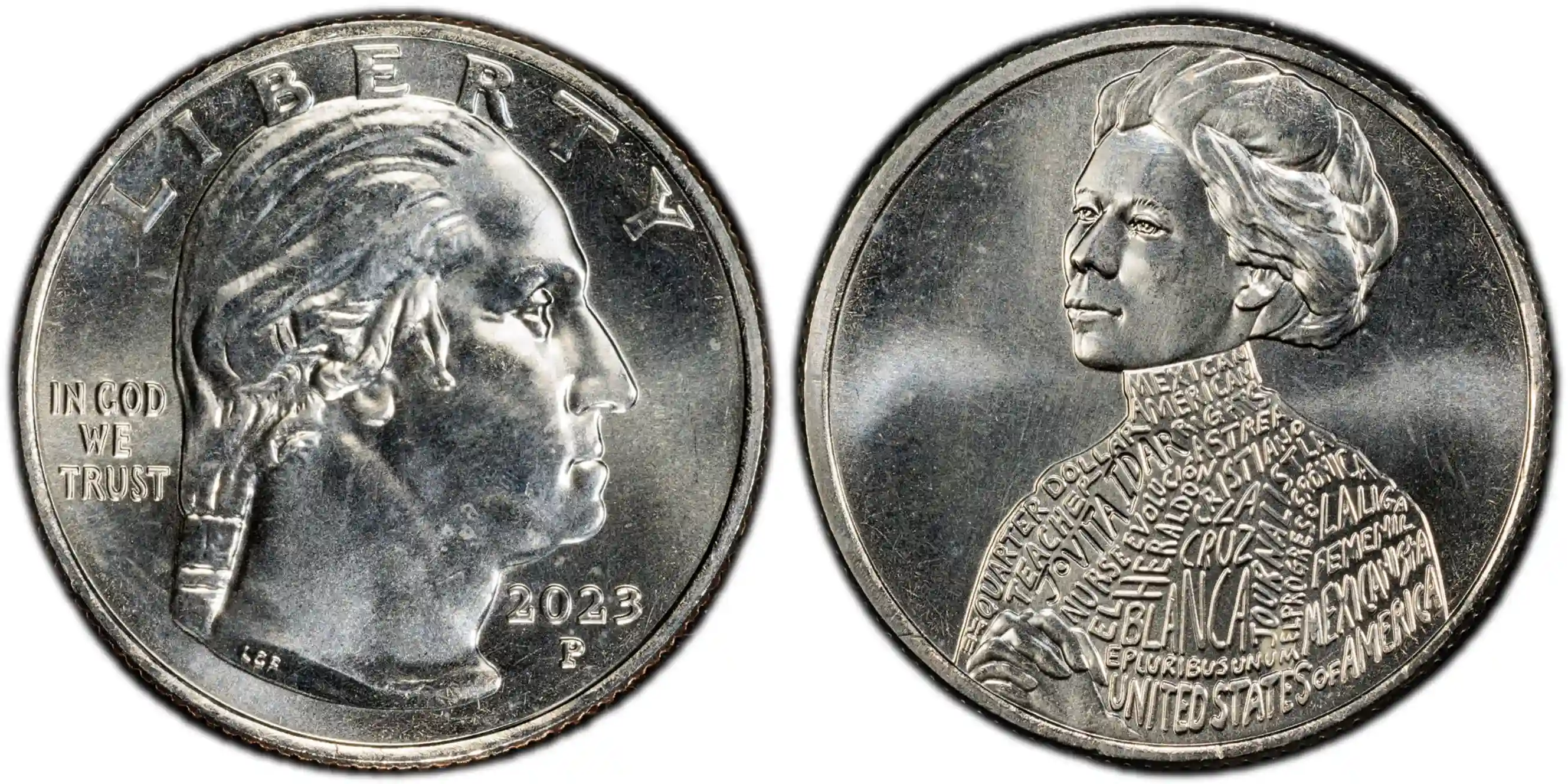
Striking phase errors happen due to a catastrophic failure of the coin press mechanics during the exact moment of impact.
Off-Center Strikes
If the feeder mechanisms fail to position the planchet squarely inside the die chamber, the strike lands off-center. A true off-center strike displays only a portion of the design while leaving a smooth, crescent-shaped piece of raw metal blank on one side.
Misaligned Dies
A misaligned die error occurs when the coin blank rests properly inside the collar, but one of the steel dies shifts out of true alignment. This leaves a normal design on one face, while the opposite side shows an off-center layout.
Missing Clad Layers on the Abstract Reverse
Modern quarters use an inner core of pure copper bonded between two outer layers of copper-nickel alloy. Severe production errors can cause one of these outer sheets to fail to bond properly before the blanking machine cuts the coin disks.
The finished quarter features a bright, silver-colored obverse face.
The reverse face reveals a raw, deep copper-red surface across the entire abstract dress design.
Value Guide for Jovita Idar Defects
The price range fluctuates every year. Compare your item defects with the actual numismatic market and professional grading services.
Error | Common Name | Value |
Struck-Through Grease | "In Cod We Trust" | $10–$50 |
Die Crack | Hairline Fracture | $5–$20 |
Die Chip | "Forehead Mole" | $5–$15 |
Misaligned Die | Off-Center Obverse | $15–$45 |
Missing Clad Layer | Red Reverse Core | $150–$400+ |